

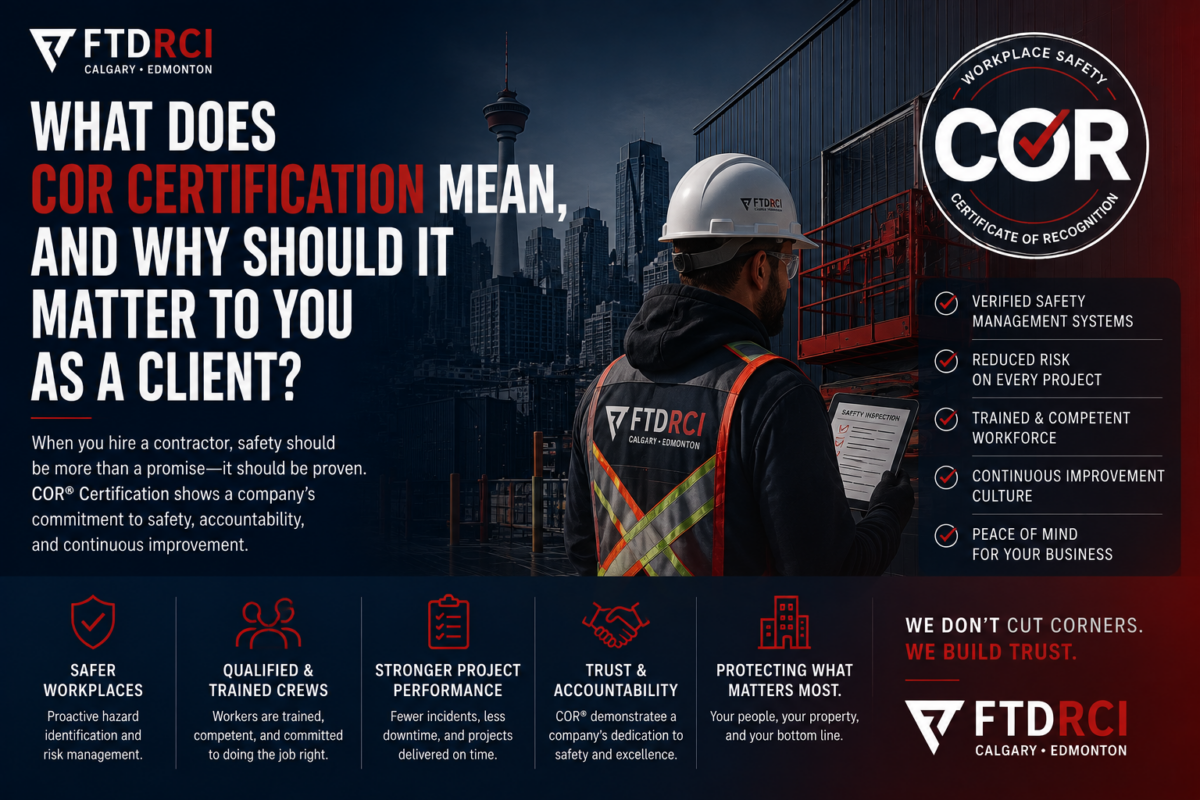
When you’re hiring a painting or coatings contractor for a commercial, industrial, or larger residential project, you’ll often see certifications like COR mentioned alongside WCB coverage and insurance. It’s easy to skim past these as boilerplate, but COR certification actually says something specific and verifiable about how a contractor manages safety on your project, and it’s worth understanding before you sign a contract.
Quick Facts
| What COR stands for | Certificate of Recognition |
| Who administers it in Alberta | The Government of Alberta, through certifying partners such as the Alberta Construction Safety Association (ACSA) |
| What it certifies | That a company has a formal health and safety management system in place, and that it is actually being followed |
| How it’s verified | Internal and external audits against a recognized safety program standard |
| Why it matters to clients | Lower project risk, fewer incidents and delays, and often a requirement for larger commercial and industrial contracts |
IMPORTANT: COR is a voluntary certification, not a legal requirement to operate. A contractor without COR isn’t necessarily unsafe, but a contractor with current COR certification has demonstrated their safety program to an independent auditor, which is more than a verbal assurance.
What COR Certification Actually Requires
COR certification is built around a documented health and safety management system covering things like hazard identification, incident reporting and investigation, worker training and orientation, inspection processes, and emergency response planning. Simply having these documents on file isn’t enough. Companies are audited internally on a regular basis and then externally by a certified auditor to confirm the program is actually being implemented on real job sites, not just written down.
In Alberta, COR is administered through the Government of Alberta’s Certificate of Recognition program, with organizations like the Alberta Construction Safety Association acting as certifying partners for the construction industry. Maintaining certification requires ongoing audits, not a one-time application, so a current COR status reflects an active, maintained safety program rather than a credential earned once and forgotten.
Why This Matters When You’re Hiring a Contractor
Safety certification might seem like an internal concern for the contractor, but it directly affects you as a client in a few practical ways.
- Fewer disruptions to your schedule. Incidents on site cause delays, whether it’s an injury, an equipment issue, or a stop-work situation triggered by a hazard. A well-managed safety program reduces how often these disruptions happen.
- Lower liability exposure. For commercial property owners and facility managers, working with a COR-certified contractor can reduce your own liability exposure in the event something does go wrong on site.
- Often a contractual requirement. Many larger commercial, institutional, and industrial clients, along with general contractors on tendered projects, require COR certification as a condition of bidding or being awarded work.
- A signal of overall operational maturity. A company that maintains a documented, audited safety program often brings that same discipline to scheduling, communication, and quality control.
CLIENT TIP: Don’t just take a COR mention at face value. Ask for the certificate and confirm it’s current, since certification requires maintenance audits and can lapse if a company doesn’t keep up with the program.
COR Compared to Other Common Safety Credentials
COR is often mentioned alongside other credentials, and each one covers something different.
| Credential | What It Covers |
|---|---|
| COR (Certificate of Recognition) | Audited, company-wide health and safety management system |
| WCB coverage | Workers’ compensation insurance for workplace injuries; a coverage requirement, not a safety-program certification |
| WHMIS training | Individual worker training on hazard communication and safe handling of chemicals and materials |
| POST certification | Site-specific safety training required for workers on oil and gas facilities |
| ACSA membership | Membership in Alberta’s construction safety association, often the certifying body for COR |
A contractor can hold several of these at once, and together they paint a fuller picture of how seriously a company takes safety, from company-wide systems down to individual worker training and site-specific requirements.
Common Questions
Is COR certification required by law?
No, COR is a voluntary program. However, many larger commercial, institutional, and industrial clients require it as a condition of hiring or awarding a contract, particularly for larger or higher-risk projects.
Does COR certification cost more for the client?
Not directly. The cost of maintaining certification is absorbed by the contractor as part of running their business, similar to insurance and WCB coverage, rather than billed as a separate line item to clients.
How do I confirm a contractor’s COR certification is current?
Ask the contractor directly for their current certificate, which should show the certifying body and validity period. Certifying organizations such as the Alberta Construction Safety Association can also typically confirm a member’s current status.
Does COR certification apply to residential projects too?
COR is most commonly discussed in the context of commercial and industrial work, since that’s typically where it’s contractually required, but a COR-certified contractor applies the same safety-managed approach across all of its projects, residential included.
Questions Worth Asking Any Contractor Before Hiring
- Are you currently COR certified, and can you provide the certificate
- Do you carry active WCB coverage for all workers on site
- Is your crew WHMIS trained and, if relevant, POST certified for site access
- What does your safety orientation process look like for a new site
- How are incidents or near misses documented and reported
Conclusion
COR certification is one of the clearest signals a client can look for when evaluating a contractor’s approach to safety. It reflects an audited, maintained safety management system rather than a one-time credential, and it directly affects project risk, schedule reliability, and liability exposure. Asking the right questions upfront, and confirming certifications rather than assuming them, protects your project as much as it protects the crew doing the work.
WANT TO CONFIRM OUR SAFETY CREDENTIALS? Contact FTDRCI to request our current COR certificate, WCB standing, or discuss safety requirements for your specific project or site.