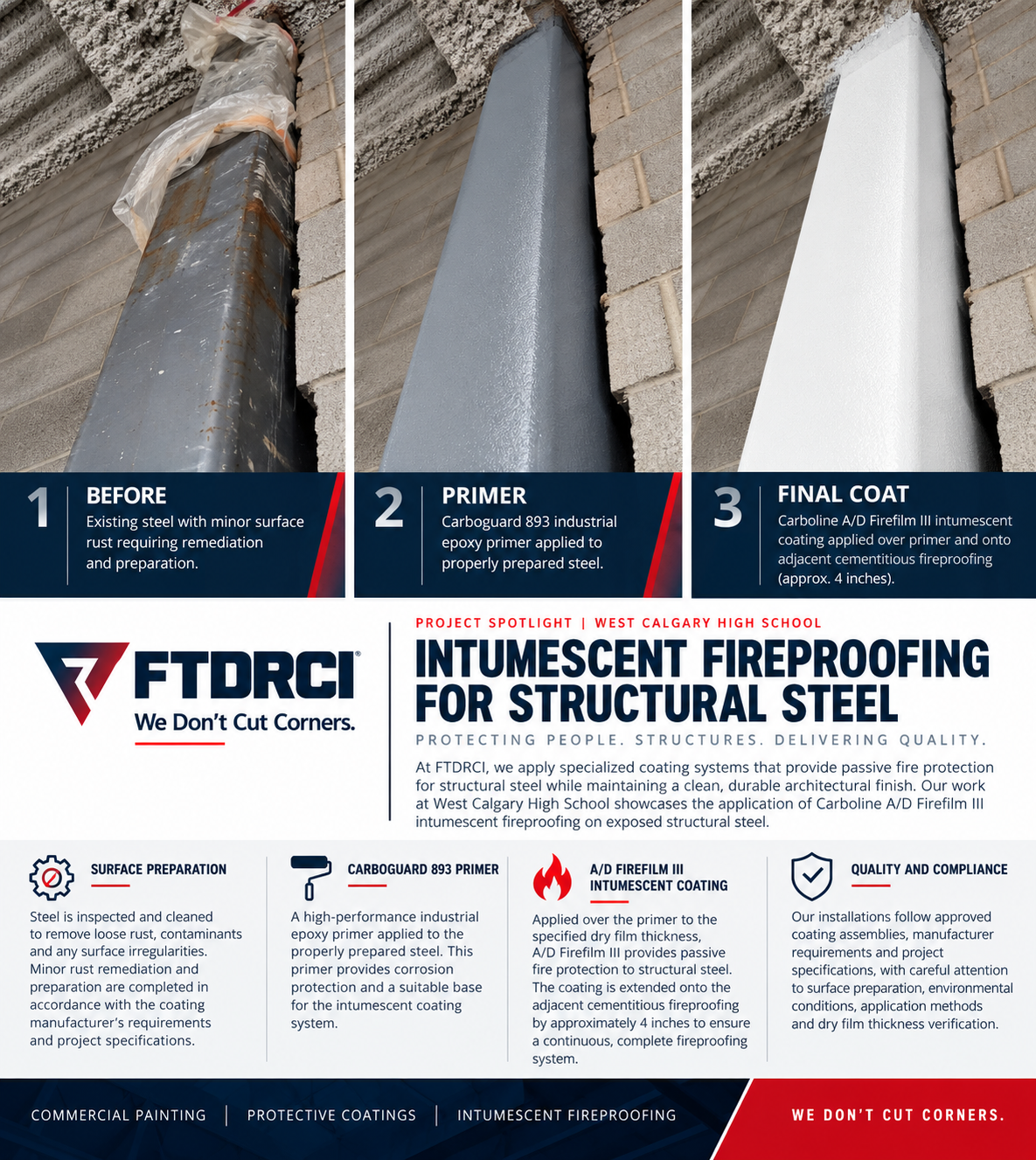
At FTDRCI, we believe that a quality coating system should do more than look good. It should serve a purpose, perform as intended, and provide lasting value to the building it protects.
Our intumescent fireproofing work at West Calgary High School highlights the specialized preparation, coating application, and attention to detail involved in protecting exposed structural steel.
Using Carboline protective coating products, including Carboguard 893 epoxy primer and A/D Firefilm III intumescent fireproofing, this project demonstrates the transformation of exposed structural steel into a clean, architecturally finished element designed to contribute to passive fire protection.
Project at a Glance
Project
West Calgary High School
Scope
Intumescent fireproofing of exposed structural steel
Surface preparation
Inspection, cleaning and minor rust remediation
Primer
Carboline Carboguard 893 industrial epoxy primer
Fireproofing
Carboline A/D Firefilm III thin-film intumescent coating
Finish
Clean, white architectural surface
What Is Intumescent Fireproofing?
Intumescent fireproofing is a specialized coating technology designed to protect structural steel during a fire. Unlike conventional architectural paint, intumescent coatings react when exposed to high temperatures. The coating expands to form an insulating char layer, slowing the transfer of heat to the steel beneath.
This is particularly important because structural steel can lose strength as temperatures rise, potentially affecting the building’s structural integrity. Intumescent coatings help provide the required fire-resistance performance when installed as part of an approved, tested assembly. One of their major advantages is that they can accomplish this without concealing the architectural appearance of the steel.
Stage 1: Surface Preparation and Minor Rust Remediation
Every successful protective coating system begins with the substrate. Before applying the primer, structural steel is inspected for surface rust, contamination, loose material, and other conditions that may compromise coating adhesion.
Where minor corrosion is present, appropriate rust remediation and surface preparation are completed in accordance with the coating manufacturer’s requirements and project specifications.
FTDRCI PRO TIP: Proper preparation is critical. Even the best coating system cannot perform as intended over a contaminated or poorly prepared surface.
Stage 2: Industrial Epoxy Primer — Carboguard 893
Following surface preparation, the structural steel receives an industrial epoxy primer. Carboguard 893 is a high-solids, corrosion-resistant epoxy coating designed for protecting steel substrates. The primer provides a protective barrier against corrosion and establishes a uniform surface for subsequent coatings.
For intumescent applications, primer selection, compatibility, curing, and application requirements must be verified against the approved fireproofing system.
Stage 3: A/D Firefilm III Intumescent Coating
The final stage involves applying Carboline A/D Firefilm III, a thin-film intumescent coating specifically designed for structural steel fire protection. Applied over a compatible, properly prepared primer system, Firefilm III provides passive fire protection while maintaining the shape and architectural profile of the steel.
The coating is applied to the specified dry film thickness required by the applicable fire-resistance design. The finished result is a clean, white architectural surface.
Integrating Different Fireproofing Systems
Structural columns, beams, and connections may intersect with areas protected by cementitious spray-applied fire-resistive material. These interfaces require careful coordination to ensure the transition meets approved project details and applicable fireproofing requirements.
In this installation, the intumescent coating was extended approximately four inches onto the adjacent cementitious fireproofing to create a continuous transition between the two systems.
Why Quality Control Matters
Intumescent fireproofing is not simply another coat of paint. Its performance depends on:
Appropriate steel preparation
Primer compatibility
Environmental conditions
Proper application
Specified dry film thickness
Compliance with approved fire-resistance designs and manufacturer requirements
Each stage plays an important role in the completed system.
IMPORTANT: Intumescent coatings do not create a fire rating on their own. Performance depends on the full approved system being installed and verified as specified.
Expanding Our Specialized Coating Capabilities
As commercial and institutional buildings become increasingly complex, specialized coating systems are playing a greater role in construction. FTDRCI continues to develop its capabilities in protective and intumescent coatings, providing general contractors, construction managers, and building owners with specialized application services.
Protecting What Matters
Intumescent fireproofing combines building safety, technical coating performance, and architectural design. By combining proper substrate preparation, protective priming, and specialized fireproofing applications, exposed structural steel can maintain its intended appearance while contributing to a building’s passive fire protection strategy.
FTDRCI — WE DON’T CUT CORNERS. Commercial Painting | Protective Coatings | Intumescent Fireproofing. Planning a project that involves structural steel fire protection? Contact FTDRCI to discuss your requirements.
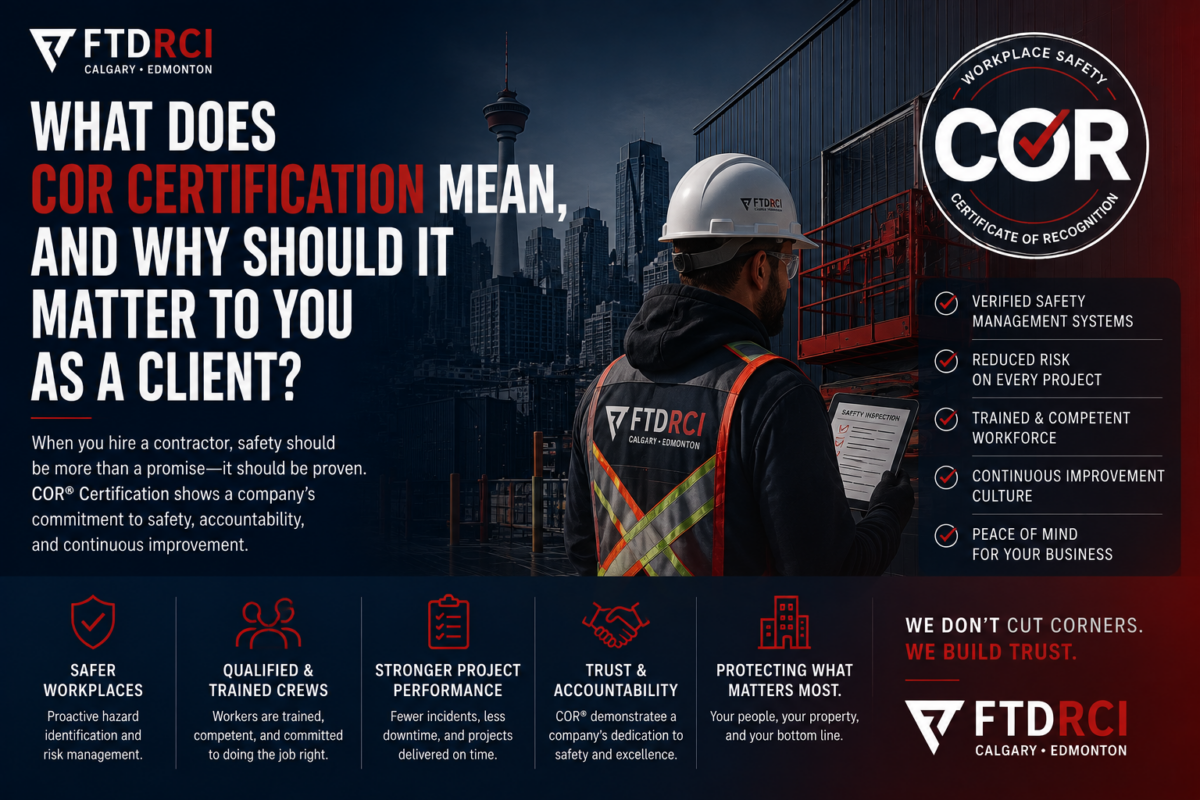
When you’re hiring a painting or coatings contractor for a commercial, industrial, or larger residential project, you’ll often see certifications like COR mentioned alongside WCB coverage and insurance. It’s easy to skim past these as boilerplate, but COR certification actually says something specific and verifiable about how a contractor manages safety on your project, and it’s worth understanding before you sign a contract.
Quick Facts
What COR stands for
Certificate of Recognition
Who administers it in Alberta
The Government of Alberta, through certifying partners such as the Alberta Construction Safety Association (ACSA)
What it certifies
That a company has a formal health and safety management system in place, and that it is actually being followed
How it’s verified
Internal and external audits against a recognized safety program standard
Why it matters to clients
Lower project risk, fewer incidents and delays, and often a requirement for larger commercial and industrial contracts
IMPORTANT: COR is a voluntary certification, not a legal requirement to operate. A contractor without COR isn’t necessarily unsafe, but a contractor with current COR certification has demonstrated their safety program to an independent auditor, which is more than a verbal assurance.
What COR Certification Actually Requires
COR certification is built around a documented health and safety management system covering things like hazard identification, incident reporting and investigation, worker training and orientation, inspection processes, and emergency response planning. Simply having these documents on file isn’t enough. Companies are audited internally on a regular basis and then externally by a certified auditor to confirm the program is actually being implemented on real job sites, not just written down.
In Alberta, COR is administered through the Government of Alberta’s Certificate of Recognition program, with organizations like the Alberta Construction Safety Association acting as certifying partners for the construction industry. Maintaining certification requires ongoing audits, not a one-time application, so a current COR status reflects an active, maintained safety program rather than a credential earned once and forgotten.
Why This Matters When You’re Hiring a Contractor
Safety certification might seem like an internal concern for the contractor, but it directly affects you as a client in a few practical ways.
Fewer disruptions to your schedule. Incidents on site cause delays, whether it’s an injury, an equipment issue, or a stop-work situation triggered by a hazard. A well-managed safety program reduces how often these disruptions happen.
Lower liability exposure. For commercial property owners and facility managers, working with a COR-certified contractor can reduce your own liability exposure in the event something does go wrong on site.
Often a contractual requirement. Many larger commercial, institutional, and industrial clients, along with general contractors on tendered projects, require COR certification as a condition of bidding or being awarded work.
A signal of overall operational maturity. A company that maintains a documented, audited safety program often brings that same discipline to scheduling, communication, and quality control.
CLIENT TIP: Don’t just take a COR mention at face value. Ask for the certificate and confirm it’s current, since certification requires maintenance audits and can lapse if a company doesn’t keep up with the program.
COR Compared to Other Common Safety Credentials
COR is often mentioned alongside other credentials, and each one covers something different.
Credential
What It Covers
COR (Certificate of Recognition)
Audited, company-wide health and safety management system
WCB coverage
Workers’ compensation insurance for workplace injuries; a coverage requirement, not a safety-program certification
WHMIS training
Individual worker training on hazard communication and safe handling of chemicals and materials
POST certification
Site-specific safety training required for workers on oil and gas facilities
ACSA membership
Membership in Alberta’s construction safety association, often the certifying body for COR
A contractor can hold several of these at once, and together they paint a fuller picture of how seriously a company takes safety, from company-wide systems down to individual worker training and site-specific requirements.
Common Questions
Is COR certification required by law?
No, COR is a voluntary program. However, many larger commercial, institutional, and industrial clients require it as a condition of hiring or awarding a contract, particularly for larger or higher-risk projects.
Does COR certification cost more for the client?
Not directly. The cost of maintaining certification is absorbed by the contractor as part of running their business, similar to insurance and WCB coverage, rather than billed as a separate line item to clients.
How do I confirm a contractor’s COR certification is current?
Ask the contractor directly for their current certificate, which should show the certifying body and validity period. Certifying organizations such as the Alberta Construction Safety Association can also typically confirm a member’s current status.
Does COR certification apply to residential projects too?
COR is most commonly discussed in the context of commercial and industrial work, since that’s typically where it’s contractually required, but a COR-certified contractor applies the same safety-managed approach across all of its projects, residential included.
Questions Worth Asking Any Contractor Before Hiring
Are you currently COR certified, and can you provide the certificate
Do you carry active WCB coverage for all workers on site
Is your crew WHMIS trained and, if relevant, POST certified for site access
What does your safety orientation process look like for a new site
How are incidents or near misses documented and reported
Conclusion
COR certification is one of the clearest signals a client can look for when evaluating a contractor’s approach to safety. It reflects an audited, maintained safety management system rather than a one-time credential, and it directly affects project risk, schedule reliability, and liability exposure. Asking the right questions upfront, and confirming certifications rather than assuming them, protects your project as much as it protects the crew doing the work.
WANT TO CONFIRM OUR SAFETY CREDENTIALS? Contact FTDRCI to request our current COR certificate, WCB standing, or discuss safety requirements for your specific project or site.
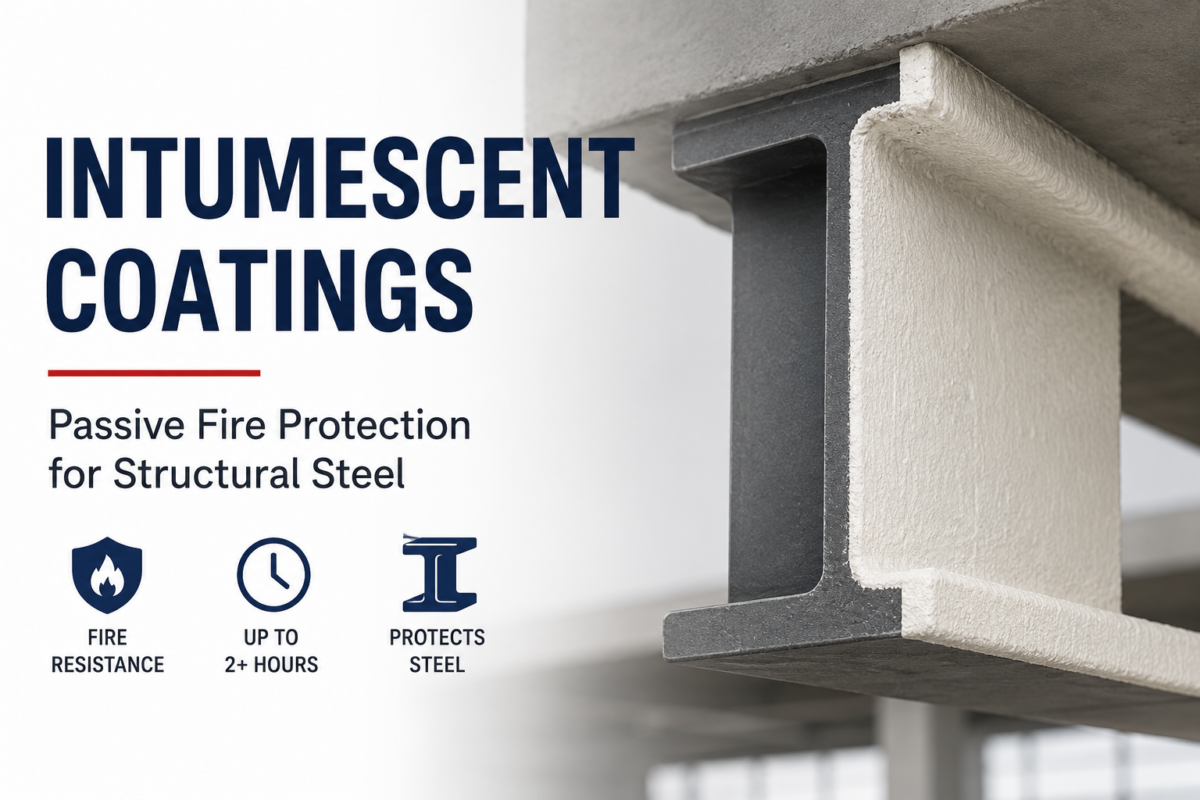
Intumescent coatings are reactive passive fire-protection materials commonly used to protect structural steel. Under normal conditions, they function as a protective coating system. When exposed to sufficient heat, the coating undergoes a controlled chemical reaction and expands to form a much thicker, low-density insulating char. This char slows the transfer of heat into the steel, helping the protected member maintain its structural function for the period required by the approved fire-resistance design.
The key point is that the coating alone does not create a universal fire rating. Fire resistance is established through a tested and listed system that may depend on the steel member, section factor, exposure, required rating, primer, intumescent product, dry-film thickness, topcoat and installation conditions. The project specification, approved listing and manufacturer’s written instructions must therefore be treated as the governing documents.
Quick Facts
Primary purpose
Delay heating of structural steel during a fire.
Typical use
Exposed or concealed structural steel in commercial, institutional and industrial construction.
How it reacts
Expands under heat to form an insulating char.
Fire-resistance duration
System-specific; commonly specified in minutes or hours.
Application methods
Usually airless spray; brush or roller may be permitted for limited work, depending on the product.
Most important controls
Approved design, primer compatibility, environmental conditions, wet-film thickness, dry-film thickness and final inspection.
IMPORTANT: The phrase fireproof paint is commonly used, but it can be misleading. Intumescent coatings do not make steel immune to fire. They delay heat transfer as one component of a tested fire-resistance system.
Why Structural Steel Needs Passive Fire Protection
Structural steel is strong, efficient and non-combustible, but non-combustible does not mean unaffected by fire. Steel conducts heat readily. As temperature rises, its stiffness and load-carrying capacity decline, and protected members can begin to deflect, distort or buckle before the steel approaches its melting point.
Passive fire protection is intended to slow that heating process. It works without a person turning it on and without relying on electrical power or mechanical activation. Intumescent coatings, spray-applied fire-resistive materials, boards, encasement and other systems can all be used to protect structural elements, depending on the design and project requirements.
The required solution cannot be selected by appearance alone. A beam, column, hollow structural section and connection may require different thicknesses or details. The amount of steel surface exposed relative to the member’s mass also affects how quickly the member heats. For that reason, intumescent thickness schedules are normally tied to member geometry and the specific approved design.
FTDRCI PRO TIP: Before pricing, confirm the approved fire-resistance design, required rating, steel member schedule, exposure conditions, approved primer and topcoat, and who is responsible for repairs after other trades damage the finished coating. A vague specification can create major estimating and scheduling risk.
How Intumescent Coatings Work
An intumescent coating is formulated to remain stable during normal service and react when it reaches an elevated activation temperature. As heat increases, the coating softens and its reactive ingredients generate gases and carbon-rich material. The expanding material forms a cellular char that is much thicker than the original coating film.
The char is effective because it is a poor conductor of heat. Instead of allowing furnace or fire temperatures to reach the steel rapidly, the expanded layer acts as insulation and reduces the rate of temperature rise. The char is sacrificial: it is intended to form and perform during fire exposure, not to remain as a normal service finish afterward.
Different products form different types of char and are designed for different hazards. Thin-film products are commonly associated with cellulosic building-fire exposures and architectural steel. More robust epoxy-based systems may be selected for demanding industrial or exterior service and for specific hydrocarbon-fire or jet-fire designs. Product selection must follow the tested listing and intended exposure; one intumescent product should never be assumed equivalent to another.
A Typical Intumescent Coating System
An intumescent installation is normally a coating system rather than a single product. A typical system may include the prepared steel substrate, a compatible primer, the intumescent fire-protection layer and, where required, an approved sealer or topcoat. Every layer must be compatible with the tested system and the service environment.
Layer
Primary Function
Key Review Question
Prepared steel
Provides a clean, sound surface for the approved primer or system.
What preparation standard and profile are required?
Primer
Provides corrosion protection and a compatible bond layer.
Is the exact primer approved beneath the intumescent?
Intumescent
Provides the reactive fire-protection thickness.
What DFT is required for each member?
Topcoat / sealer
Provides colour, cleanability or environmental protection where approved.
Is it required, and is it part of the approved system?
COMMON MISTAKE: Assuming that any shop primer can remain under the intumescent. Primer compatibility must be confirmed for the exact product and approved system. An unapproved primer, excessive primer thickness or contaminated surface can affect adhesion and may invalidate the proposed assembly.
How Fire-Resistance Ratings Are Determined
Fire-resistance ratings are normally expressed as a period such as 30, 60, 90 or 120 minutes. The rating relates to the performance of a tested assembly under a defined fire-exposure test. In Canada, applicable listings and project requirements may reference Canadian testing and certification pathways such as CAN/ULC-S101, while U.S. designs commonly reference ASTM E119 or equivalent listed assemblies. Industrial hazards may require other fire curves and test methods.
A rating should not be described as a stand-alone property of a bucket of coating. The protected member, orientation, number of exposed sides, section factor, limiting steel temperature, load assumptions and coating thickness all contribute to the design. The approved listing or engineering evaluation must be reviewed before material quantities are established.
This is also why a uniform thickness across every beam and column may not be correct. Different members can require different DFT values. The applicator must have a clear thickness schedule or member-by-member instructions, and the inspection records should demonstrate that the installed film meets those requirements.
ESTIMATOR NOTE: Do not calculate intumescent quantities using floor area alone. Obtain the structural-steel takeoff, member schedule and required DFT table. Include waste, stripe or detail work, access, masking, environmental controls, inspection, repairs, topcoat and touch-ups after other trades.
Thin-Film, Epoxy and Cementitious Protection
The best fire-protection system depends on the project. Thin-film intumescent products are often selected when exposed steel requires an architectural appearance. Epoxy intumescent systems are generally more robust and may be used for demanding industrial service or specialized fire exposures. Cementitious or fibrous spray-applied fire-resistive materials can provide economical protection where appearance, impact resistance or moisture exposure are less critical.
System
Typical Strength
Typical Limitation
Common Setting
Thin-film intumescent
Smooth finish and exposed-steel aesthetics.
Sensitive to approved system, environment and application thickness.
Commercial and institutional exposed steel.
Epoxy intumescent
Durability and performance in demanding exposures.
Higher material cost and specialized application requirements.
Industrial, exterior or hydrocarbon-rated systems where approved.
Cementitious / SFRM
Efficient coverage and established fire protection.
Rougher appearance; can require protection from impact or moisture.
Concealed structural steel and large floor areas.
Surface Preparation and Primer Compatibility
The intumescent layer can only perform as intended if it remains bonded to the substrate and underlying primer. Surface preparation therefore begins with the project specification, manufacturer’s product data and approved design. Requirements may differ for new steel, existing coatings, galvanized surfaces, shop-primed steel, damaged primer and field repairs.
Typical pre-application checks include cleanliness, primer identity, primer DFT, cure, adhesion, contamination, corrosion, damage and compatibility. Oil, grease, dust, soluble contamination, rust bloom, overspray and construction debris can all affect coating performance. Where the existing primer is unknown or outside the approved system, written direction should be obtained before application proceeds.
Environmental conditions are equally important. Steel temperature, air temperature, relative humidity, dew point, ventilation and forecast conditions must remain within the product’s written limits during application and curing. Enclosures and temporary heat may be required in Canadian construction, but heating and ventilation must be managed so that condensation, combustion by-products or uneven curing are not introduced.
PROJECT MANAGER NOTE: Coordinate steel inspection before the intumescent crew mobilizes. Unresolved primer questions, incomplete welding, missing clips, ongoing steel modifications and damage from follow-on trades can cause remobilization, repairs and disputed responsibility.
Application and Quality-Control Basics
Intumescent coatings are commonly applied by airless spray because the required film build can be substantial and the work often involves complex structural shapes. Brush or roller application may be permitted for small areas, stripe work or repairs, but only where allowed by the manufacturer. The specified thickness is normally built in multiple passes or coats, with required drying intervals between applications.
Wet-film thickness measurements help the applicator control each coat while work is in progress. After curing, dry-film thickness measurements verify the installed coating. DFT inspection should be recorded by member or inspection area and evaluated against the approved thickness schedule. Excessive thickness can be a concern as well as insufficient thickness because heavy application can affect drying, appearance, cracking or adhesion.
Quality control should also address finish, damage, adhesion concerns, pinholes, cracking, mud-cracking, contamination, incomplete coverage at edges and connections, and the condition of the topcoat. Repairs should follow a documentedmanufacturer-approved method rather than an improvised patching approach.
INSPECTOR NOTE: Confirm the correct substrate or primer calibration method, measurement procedure and acceptance criteria before inspection begins. DFT results must be compared with the approved member schedule, not a generic project average.
Common Questions and RFIs
Is intumescent coating the same as fireproof paint?
Fireproof paint is an informal description. Intumescent is a reactive passive fire-protection coating used as part of an approved system; it does not make steel permanently immune to fire.
Can it be applied over any primer?
No. The exact primer and primer thickness should be confirmed as compatible with the intumescent product and approved design.
Does every steel member receive the same thickness?
Not necessarily. Required DFT can vary according to member geometry, section factor, exposure and required rating.
Can intumescent be left exposed outdoors?
Only when the selected system is approved for the exposure and includes any required sealer or topcoat. Environmental classification and maintenance requirements should be confirmed.
Can damaged intumescent be repaired?
Often yes, but the repair procedure should follow the manufacturer’s written instructions and project requirements. The cause and depth of damage must first be assessed.
Who confirms the final fire rating?
The required rating and accepted assembly are determined through the design, specification, approved listing or engineering evaluation, and acceptance by the relevant authority or project team. The installer applies and documents the specified system.
What Should Be Confirmed Before Tender or Mobilization?
Approved fire-resistance design and required rating for each area
Complete structural-steel schedule with member sizes and section factors
Approved primer and confirmation it is compatible with the specified intumescent
Required dry-film thickness by member, not a single blanket number
Environmental conditions and any enclosure/heating requirements during application
Access, staging and sequencing with other trades
Masking and protection requirements for adjacent finishes
Inspection and documentation requirements, including DFT records
Repair procedure and responsibility for damage caused by other trades
Topcoat or sealer requirements, if any
Warranty and manufacturer certification requirements
Who reviews and signs off on the completed fireproofing system
FTDRCI FIELD NOTE: Most fireproofing disputes come from unclear scope, not poor workmanship. Confirming these items up front helps protect both the schedule and the budget.
Conclusion
Intumescent coatings play a critical role in protecting structural steel during a fire, but they only work as intended when the full system—including substrate preparation, primer, coating thickness and topcoat—matches an approved, tested design. Getting the details right at the specification and estimating stage prevents costly rework and keeps a project on schedule.
Every project is different, and the right system depends on the exposure, the structure and the approved design. If you are scoping a project that involves passive fire protection, we are happy to help review the requirements with you.
NEED HELP WITH A FIREPROOFING PROJECT? Contact FTDRCI to discuss your structural steel fire-protection requirements, get a quote, or ask a technical question about your specification.