

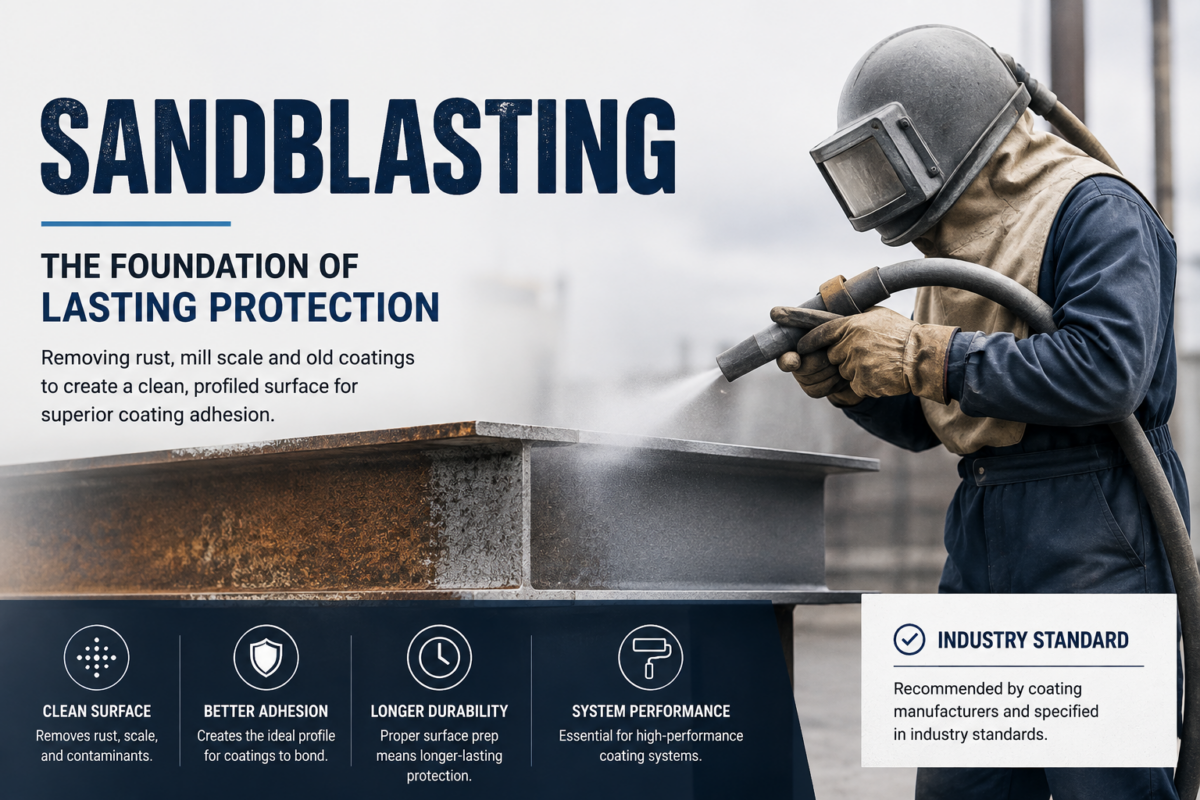
Sandblasting, more accurately called abrasive blasting, is a surface preparation process that propels abrasive media at high velocity to remove rust, old coatings, mill scale and contamination from a surface. The result is a clean substrate with a specific texture, or profile, that allows a new coating or finish to bond properly.
The name comes from its traditional abrasive, silica sand, which is rarely used in professional settings today because of the health risks associated with airborne silica dust. Modern blasting relies on safer, more controlled media selected for the substrate and the job. The term sandblasting has simply stuck as the everyday way to describe the process.
Quick Facts
| Primary purpose | Remove rust, old coatings and contamination while creating a surface profile for adhesion. |
| Typical use | Structural steel, concrete floors, masonry, equipment and tanks before recoating. |
| How it works | Compressed air propels abrasive media against the surface at high speed. |
| Common media | Aluminum oxide, garnet, steel grit, glass bead, soda, walnut shell. |
| Application settings | Industrial, commercial, oil and gas, marine, and select residential restoration work. |
| Most important controls | Correct media selection, surface profile, containment, and operator safety equipment. |
IMPORTANT: Sandblasting is not a cosmetic step. The industry uses it primarily to prepare a surface so that a new coating bonds correctly and lasts. Skipping or rushing this step is one of the most common reasons a paint or coating system fails early.
How Sandblasting Works
Abrasive media is loaded into a pressure vessel, or blast pot, and compressed air pushes it through a hose and out a nozzle at high speed. When the media strikes the surface, it mechanically removes rust, failing paint, mill scale and debris while also roughening the surface at a microscopic level. That roughened texture, known as a surface profile, gives a new coating something to physically grip rather than simply sit on top of.
Spent media, paint chips and dust are managed differently depending on the setting. Open blasting is common in outdoor industrial environments, while vacuum recovery or contained blasting is used where dust control matters, such as occupied buildings, urban sites or projects involving older coatings that may contain lead.
Choosing the Right Abrasive Media
Not every job calls for the same abrasive. The right choice depends on the substrate, how aggressive the cleaning needs to be, and whether the finished surface needs to hold a specific profile for a coating system.
| Media | Typical Use |
|---|---|
| Aluminum oxide | Aggressive cutting on hard surfaces; reusable |
| Garnet | Aggressive with lower dust; common in industrial and marine work |
| Steel grit / steel shot | Heavy-duty industrial prep on structural steel |
| Glass bead | Gentler cosmetic cleaning without removing much base material |
| Soda (sodium bicarbonate) | Very gentle; delicate substrates like fiberglass and historic masonry |
| Walnut shell / corn cob | Organic and non-metallic; used where the substrate cannot be scratched |
FTDRCI TIP: If dust control or noise is a concern, such as on an occupied commercial property, ask about bristle blasting or contained blasting methods. They achieve a comparable surface result with far less airborne dust than open abrasive blasting.
Why Surface Preparation Determines Coating Lifespan
Paint and protective coatings applied over rust, mill scale, grease or a smooth existing surface will not bond correctly, no matter how good the coating itself is. Manufacturers of high-performance coatings, including epoxies, polyaspartics and intumescent fireproofing, specify a minimum surface preparation standard as a condition of their product warranty.
Industry standards published by SSPC, The Society for Protective Coatings, and NACE define specific surface cleanliness levels, such as a commercial blast or a near-white metal blast, along with the required surface profile before a coating system can be applied. These standards exist because coating failures are overwhelmingly a preparation problem, not a product problem.
Benefits of Sandblasting
- Stronger coating adhesion. Creates the surface profile new coatings need to bond mechanically rather than sit on top of a slick surface.
- Full removal of contamination. Strips rust, failing paint and mill scale down to sound substrate instead of painting over the problem.
- Faster than manual methods. Covers large steel structures, floors and equipment far more efficiently than hand scraping or sanding.
- Reveals true substrate condition. Once blasted clean, corrosion, pitting and structural concerns are visible and can be properly assessed.
- Extends coating lifespan. Properly prepared surfaces significantly outlast coatings applied over inadequate prep, reducing long-term maintenance costs.
- Works across substrates. With the right media, it is effective on steel, concrete, masonry, wood and fiberglass.
Where Sandblasting Is Used
Industrial and commercial projects
- Structural steel preparation before intumescent fireproofing or protective coatings
- Tanks, pipelines and process equipment in oil and gas facilities
- Warehouse and parkade concrete floor preparation before epoxy or polyaspartic systems
- Removing failed coatings from bridges, overpasses and industrial structures
- Rust and corrosion removal on machinery ahead of recoating
Commercial buildings
- Masonry and concrete facade cleaning and restoration
- Graffiti removal from brick, concrete and stone
- Parking garage surface preparation ahead of waterproofing
Residential and restoration work
- Preparing exterior siding, brick or stucco where existing coatings have failed
- Metal restoration on fences, gates and railings
- Historic building restoration using gentler media such as soda or walnut shell
- Fire and smoke damage remediation before recoating
Safety and Regulatory Considerations
Abrasive blasting is a regulated activity, and for good reason. Traditional silica sand blasting is heavily controlled because airborne silica dust causes silicosis and is classified as a carcinogen. Occupational safety regulators set specific exposure limits for respirable crystalline silica, which is part of why the industry has largely shifted to alternative media, ventilation, and vacuum recovery systems.
Operators require supplied-air respirators or blasting hoods rather than standard dust masks, along with protective suits, hearing protection and eye protection. On occupied or urban sites, containment systems such as tenting or vacuum blast attachments help control dust and protect nearby workers, tenants and the surrounding environment. Where older coatings may contain lead, spent abrasive must be handled and disposed of according to environmental regulations rather than treated as ordinary construction waste.
SAFETY NOTE: Ask any contractor performing abrasive blasting about their containment plan, respiratory protection program, and how they identify and handle lead-containing coatings before work begins. This protects your building’s occupants as much as the crew on site.
Sandblasting Compared to Other Surface Prep Methods
| Method | Best For | Trade-offs |
|---|---|---|
| Sandblasting / abrasive blasting | Heavy corrosion, thick coatings, large industrial surfaces | Requires containment and PPE; can be aggressive on soft substrates |
| Bristle blasting | Low-dust, low-profile spot repairs in sensitive environments | Slower on large areas; less aggressive |
| Chemical stripping | Delicate substrates and detailed ornamental work | Hazardous chemicals; slower; disposal concerns |
| Pressure washing | Light dirt and grime, not true corrosion removal | Does not create a surface profile for coating adhesion |
| Hand tools (wire brush, grinding) | Small spot repairs | Labour-intensive with inconsistent results on large jobs |
Common Questions
Is sandblasting safe for my home or occupied building?
Yes, when performed by a qualified contractor using appropriate containment and dust control. On occupied sites, contained or vacuum-recovery methods, or gentler alternatives such as bristle blasting, are often used specifically to limit dust and disruption.
Do I need to leave the building during blasting work?
It depends on the scope, the containment method and the area being worked on. Your contractor should outline noise, dust and access expectations before work begins so you can plan around it.
How long does sandblasting take?
Timelines vary widely based on surface area, the condition of the existing coating, the media used, and whether containment is required. A qualified contractor can provide a realistic timeline once the scope is assessed on site.
Will sandblasting damage the underlying material?
Not when the correct media and pressure are matched to the substrate. This is why media selection matters: an aggressive abrasive suited to structural steel would be the wrong choice for softer materials like historic masonry or fiberglass.
What to Confirm Before Hiring a Sandblasting Contractor
- The abrasive media proposed for your specific substrate
- Their containment and dust control plan for occupied or urban sites
- How existing coatings will be tested for lead before work begins
- The surface profile required by the coating going on afterward
- WCB coverage and relevant safety certifications
- Disposal plan for spent media and removed coating material
- A realistic timeline and any access, noise or scheduling impacts
Conclusion
Sandblasting is one of the most effective ways to prepare a surface for a coating that is meant to last. Whether the goal is protecting structural steel, restoring a concrete floor, or removing decades of failed paint from a commercial facade, the right abrasive media and process make the difference between a coating that holds up for years and one that fails within months.
Every project is different, and the right approach depends on the substrate, the environment and what is being applied afterward. If you are planning a project that involves surface preparation or coating removal, we are happy to help assess the scope.
NEED SURFACE PREPARATION OR SANDBLASTING WORK DONE? Contact FTDRCI to discuss your project, get a quote, or ask a technical question about your surface preparation requirements.