

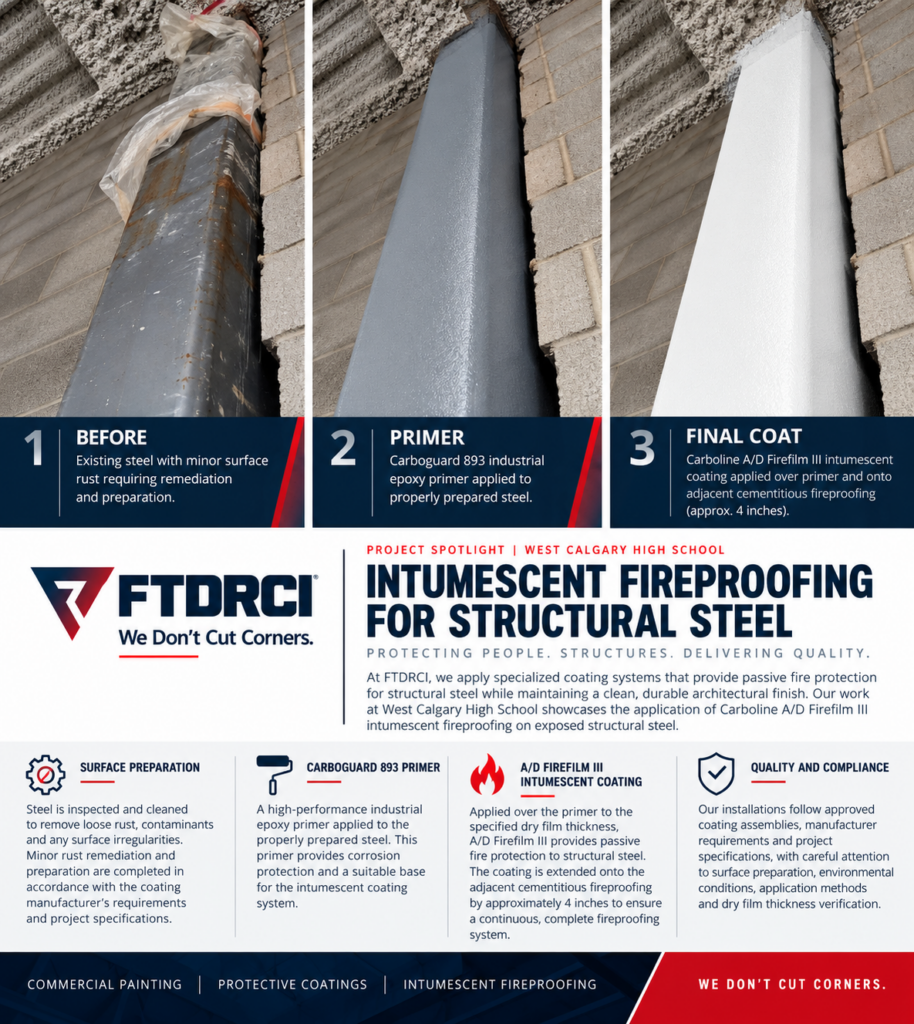
Project Spotlight | West Calgary High School
At FTDRCI, we believe that a quality coating system should do more than look good. It should serve a purpose, perform as intended, and provide lasting value to the building it protects.
Our intumescent fireproofing work at West Calgary High School highlights the specialized preparation, coating application, and attention to detail involved in protecting exposed structural steel.
Using Carboline protective coating products, including Carboguard 893 epoxy primer and A/D Firefilm III intumescent fireproofing, this project demonstrates the transformation of exposed structural steel into a clean, architecturally finished element designed to contribute to passive fire protection.
Project at a Glance
| Project | West Calgary High School |
| Scope | Intumescent fireproofing of exposed structural steel |
| Surface preparation | Inspection, cleaning and minor rust remediation |
| Primer | Carboline Carboguard 893 industrial epoxy primer |
| Fireproofing | Carboline A/D Firefilm III thin-film intumescent coating |
| Finish | Clean, white architectural surface |
What Is Intumescent Fireproofing?
Intumescent fireproofing is a specialized coating technology designed to protect structural steel during a fire. Unlike conventional architectural paint, intumescent coatings react when exposed to high temperatures. The coating expands to form an insulating char layer, slowing the transfer of heat to the steel beneath.
This is particularly important because structural steel can lose strength as temperatures rise, potentially affecting the building’s structural integrity. Intumescent coatings help provide the required fire-resistance performance when installed as part of an approved, tested assembly. One of their major advantages is that they can accomplish this without concealing the architectural appearance of the steel.
LEARN MORE: For a deeper look at how intumescent coatings work, how fire-resistance ratings are determined, and what to confirm before tender, read our guide: What Are Intumescent Coatings? A Practical Guide to Passive Fire Protection for Structural Steel.
Our Three-Stage Coating Process
Stage 1: Surface Preparation and Minor Rust Remediation
Every successful protective coating system begins with the substrate. Before applying the primer, structural steel is inspected for surface rust, contamination, loose material, and other conditions that may compromise coating adhesion.
Where minor corrosion is present, appropriate rust remediation and surface preparation are completed in accordance with the coating manufacturer’s requirements and project specifications.
FTDRCI PRO TIP: Proper preparation is critical. Even the best coating system cannot perform as intended over a contaminated or poorly prepared surface.
Stage 2: Industrial Epoxy Primer — Carboguard 893
Following surface preparation, the structural steel receives an industrial epoxy primer. Carboguard 893 is a high-solids, corrosion-resistant epoxy coating designed for protecting steel substrates. The primer provides a protective barrier against corrosion and establishes a uniform surface for subsequent coatings.
For intumescent applications, primer selection, compatibility, curing, and application requirements must be verified against the approved fireproofing system.
Stage 3: A/D Firefilm III Intumescent Coating
The final stage involves applying Carboline A/D Firefilm III, a thin-film intumescent coating specifically designed for structural steel fire protection. Applied over a compatible, properly prepared primer system, Firefilm III provides passive fire protection while maintaining the shape and architectural profile of the steel.
The coating is applied to the specified dry film thickness required by the applicable fire-resistance design. The finished result is a clean, white architectural surface.
Integrating Different Fireproofing Systems
Structural columns, beams, and connections may intersect with areas protected by cementitious spray-applied fire-resistive material. These interfaces require careful coordination to ensure the transition meets approved project details and applicable fireproofing requirements.
In this installation, the intumescent coating was extended approximately four inches onto the adjacent cementitious fireproofing to create a continuous transition between the two systems.
Why Quality Control Matters
Intumescent fireproofing is not simply another coat of paint. Its performance depends on:
- Appropriate steel preparation
- Primer compatibility
- Environmental conditions
- Proper application
- Specified dry film thickness
- Compliance with approved fire-resistance designs and manufacturer requirements
Each stage plays an important role in the completed system.
IMPORTANT: Intumescent coatings do not create a fire rating on their own. Performance depends on the full approved system being installed and verified as specified.
Expanding Our Specialized Coating Capabilities
As commercial and institutional buildings become increasingly complex, specialized coating systems are playing a greater role in construction. FTDRCI continues to develop its capabilities in protective and intumescent coatings, providing general contractors, construction managers, and building owners with specialized application services.
Protecting What Matters
Intumescent fireproofing combines building safety, technical coating performance, and architectural design. By combining proper substrate preparation, protective priming, and specialized fireproofing applications, exposed structural steel can maintain its intended appearance while contributing to a building’s passive fire protection strategy.
FTDRCI — WE DON’T CUT CORNERS. Commercial Painting | Protective Coatings | Intumescent Fireproofing. Planning a project that involves structural steel fire protection? Contact FTDRCI to discuss your requirements.


