

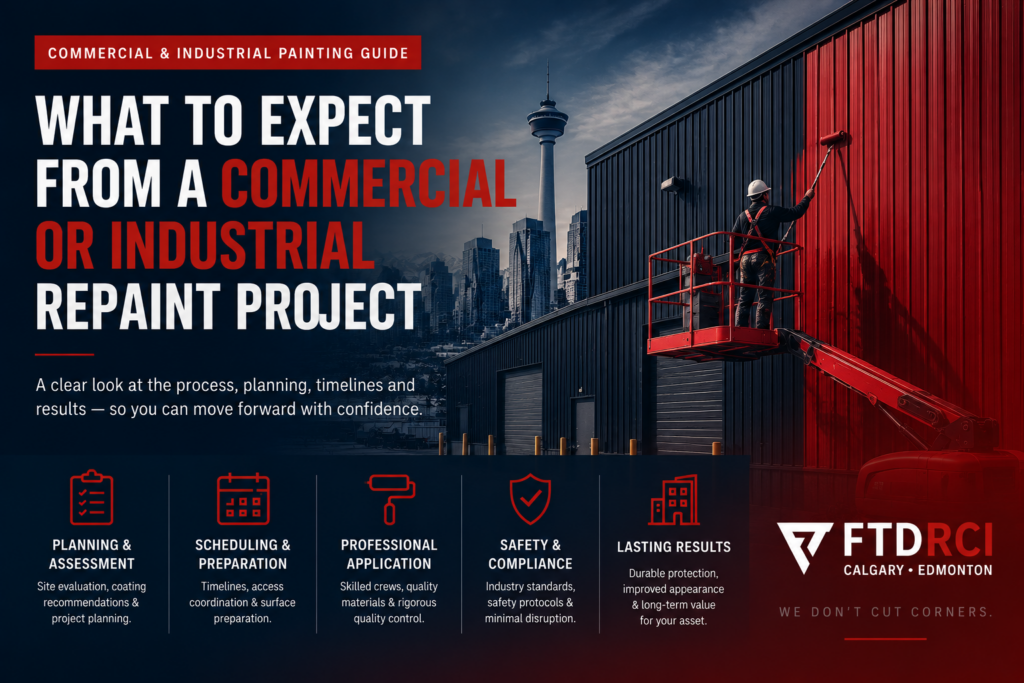
A commercial or industrial repaint is a very different undertaking than painting a house. The stakes are higher: downtime costs money, occupied spaces need to stay functional, and industrial environments often bring safety, access, and coating-performance requirements that residential work never touches. Knowing what the process actually looks like helps you plan around it instead of being surprised by it.
Quick Facts
| Typical project types | Offices, retail, warehouses, multi-residential, institutional, and industrial facilities |
| Biggest planning factor | Scheduling around occupancy and operations, not just the painting itself |
| Common scheduling approach | Evenings, weekends, or phased work by zone to minimize disruption |
| Key differentiator from residential work | Larger scale, specialized coatings, and safety/compliance requirements |
| What most affects timeline | Surface condition, site access, and how much of the facility must stay operational |
IMPORTANT: The biggest difference between a commercial repaint and a residential one is not the paint, it is the planning. Coordinating around occupants, operations, and safety requirements usually shapes the project more than the coating itself.
How Commercial and Industrial Projects Differ From Residential Work
Scale is the most obvious difference, but it is far from the only one. Commercial and industrial sites often involve multiple stakeholders, including property managers, tenants, facility staff, and sometimes multiple trades working simultaneously. Many of these spaces cannot simply close down for the duration of a paint job, which means the project has to be planned around business hours, shift schedules, or building traffic patterns.
Industrial environments add another layer entirely. Facilities like warehouses, oil and gas sites, and manufacturing plants often require specialty coatings for chemical resistance, high traffic, corrosion protection, or fire protection, along with strict safety protocols for working around equipment and active operations.
Stage One: Site Assessment and Scope
Every project starts with a walkthrough of the site to assess surface conditions, existing coatings, access points, and any specialized requirements. This is where a contractor identifies problem areas such as failing coatings, corrosion, moisture damage, or surfaces that need specialty preparation before a new coating can be applied.
This stage should also identify which areas need to remain accessible or operational throughout the project, whether any specialty coatings are required by code or facility standards, and what safety certifications or site orientations the crew will need before starting work.
PLANNING TIP: Have your contractor walk the site with your facility or operations manager, not just a property representative. Details like equipment clearances, restricted zones, and shift schedules are easy to miss if the person scoping the job isn’t familiar with day-to-day operations.
Stage Two: Scheduling Around Your Operations
Minimizing disruption is usually the top priority for commercial and industrial clients, and there are a few common approaches to achieve it.
- After-hours or overnight work. Common in retail, office, and institutional settings where daytime activity needs to continue uninterrupted.
- Weekend work. Useful for spaces with weekday-only operations, such as many office and institutional buildings.
- Phased work by zone. Breaking a large facility into sections so only part of the space is affected at any given time, common in warehouses, multi-residential buildings, and large retail spaces.
- Coordinated shutdown windows. Used in industrial settings where certain equipment or areas can only be accessed during planned maintenance or shutdown periods.
Clear communication with tenants, staff, or building occupants ahead of time also matters. Notices about work areas, expected noise or odour, and any temporary access changes go a long way toward avoiding complaints or confusion once work begins.
Stage Three: Surface Preparation
As with any paint or coating project, preparation is where most of the labour and time actually goes. On commercial and industrial sites, this often means more than scraping and sanding. Depending on the surface and existing coating condition, prep can involve pressure washing, sandblasting or abrasive blasting, patching concrete or masonry, addressing corrosion on steel, or removing failed coatings entirely before anything new goes on.
Masking and protection also becomes more involved at this scale. Equipment, signage, flooring, landscaping, and neighbouring units or tenant spaces all need to be protected from overspray and dust, particularly in occupied buildings or multi-tenant sites.
Stage Four: Coating Selection
Commercial and industrial projects frequently call for coatings selected for performance requirements rather than appearance alone. The right product depends heavily on the setting.
| Setting | Common Coating Considerations |
|---|---|
| Offices and retail | Durability, washability, low-VOC options for occupied spaces, brand-specific colour matching |
| Warehouses and industrial floors | Epoxy or polyaspartic floor systems, chemical and abrasion resistance |
| Structural steel | Corrosion protection, intumescent fireproofing where required by code |
| Multi-residential buildings | Durability in common areas, coordination across many occupied units |
| Oil and gas facilities | Specialty coatings for chemical exposure, colour coding standards, safety compliance |
COMMON MISTAKE: Choosing a coating based on cost alone without confirming it meets the performance requirements of the space. A coating that fails prematurely in a high-traffic warehouse or chemically exposed area ends up costing more in downtime and rework than a properly specified product would have.
Stage Five: Application and Site Safety
Application methods scale up for commercial and industrial work. Airless spray equipment is common for large surface areas, while brush and roller work remains standard for detail areas, trim, and touch-ups. Electrostatic spray application may be used for certain metal fixtures and equipment where an even, efficient finish is needed.
Site safety takes on more weight in these settings. Crews working in active industrial facilities need proper safety orientation, appropriate certifications, and awareness of site-specific hazards. WCB coverage, COR certification, and site-specific safety training are standard expectations for a contractor working in this space, not optional extras.
Stage Six: Final Walkthrough and Sign-Off
A completed project should include a final walkthrough to confirm coverage, finish quality, and that all areas were completed to specification. For larger projects, this often includes documentation such as photos, coating batch information, or dry-film thickness records where a specific coating system was required. Any touch-ups or deficiencies identified during the walkthrough should be addressed before the project is considered complete.
Common Questions
Can a commercial repaint be done without closing the business?
In most cases, yes. After-hours, weekend, or phased scheduling is standard practice specifically to avoid disrupting business operations.
How long does a commercial or industrial repaint typically take?
Timelines vary widely based on square footage, surface condition, and whether the site can be worked continuously or only in scheduled windows. A proper site assessment is the only way to get a realistic timeline for a specific project.
Do industrial sites require special certifications from the painting contractor?
Often, yes. Oil and gas, manufacturing, and similar facilities frequently require site-specific safety orientation and may require certifications such as COR or POST training before a crew can be granted site access.
What happens if there’s an odour or air quality concern in an occupied building?
Low-VOC coatings and proper ventilation planning can significantly reduce odour and air quality impact. This is worth raising during the scoping stage if the space will remain occupied during the work.
What to Confirm Before a Commercial or Industrial Repaint
- Scope of work and which areas or coatings are included
- Proposed schedule and how it accounts for your operating hours
- Which coatings are specified and why, especially for specialty applications
- Safety certifications, WCB coverage, and insurance
- Plan for protecting equipment, tenants, or occupants during work
- Communication plan for notifying tenants, staff, or occupants ahead of work
- Final walkthrough and documentation process for sign-off
Conclusion
A commercial or industrial repaint involves far more coordination than a typical residential job, from scheduling around operations to selecting the right coating system for the environment. Knowing what to expect at each stage, assessment, scheduling, preparation, coating selection, application, and sign-off, makes it easier to plan the project with minimal disruption to your business.
Every facility has different operational needs, and the right approach depends on your specific site, schedule, and coating requirements. We are happy to walk through your space and put together a plan that works around your operations.
PLANNING A COMMERCIAL OR INDUSTRIAL REPAINT? Contact FTDRCI to discuss your project scope, schedule, and coating requirements, and get a detailed plan built around your operations.


